
AI Agents vs Chatbots in 2026: How Small Businesses Can Automate Work Without Wasting Money
By the Innotechz | Last updated: October 24, 2026 | 8-minute read
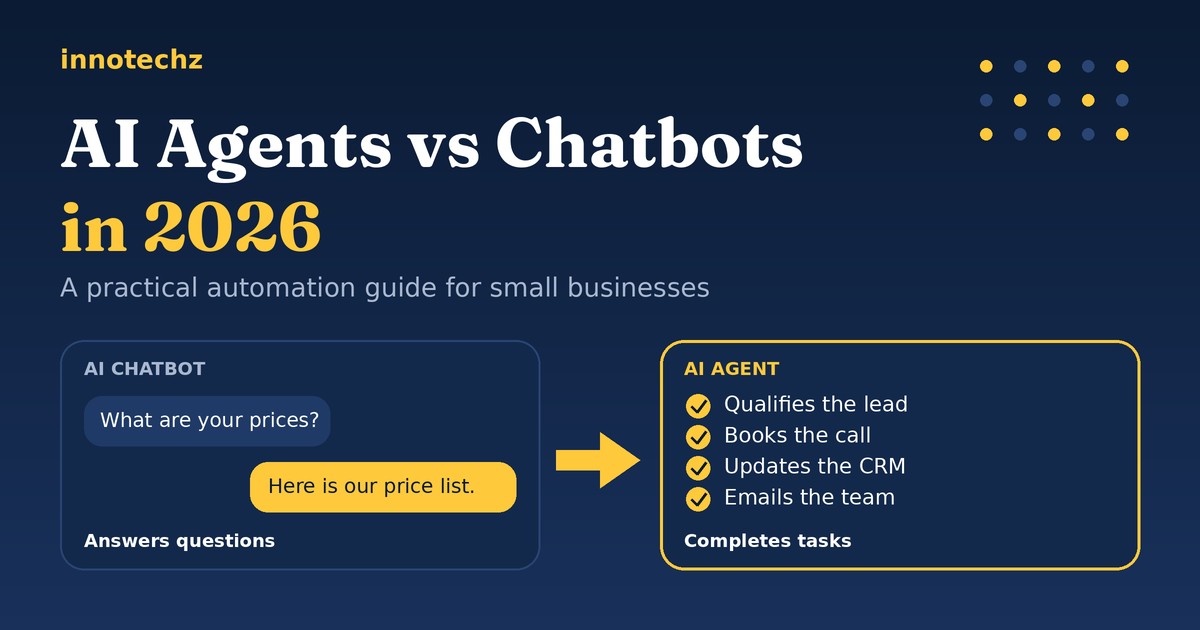
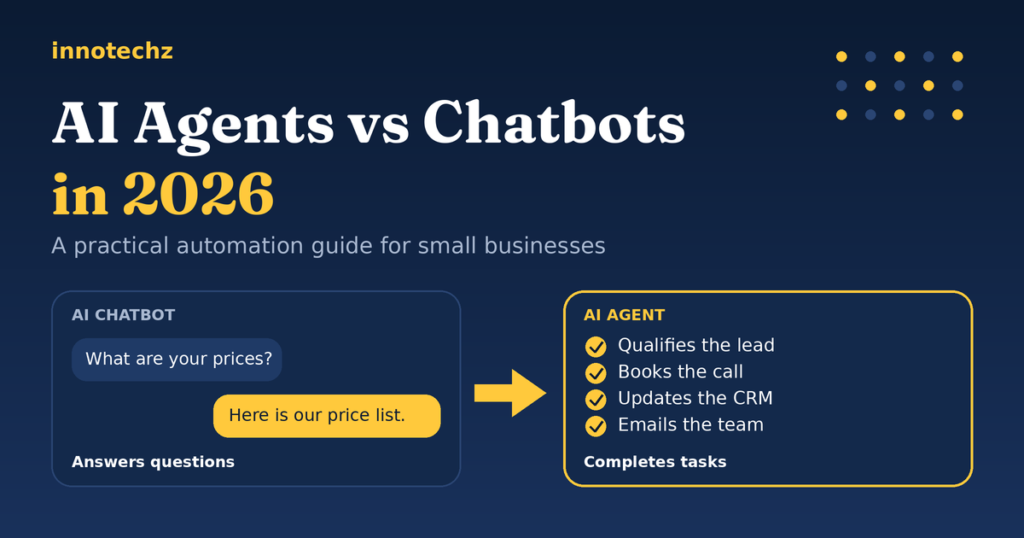
Quick answer: A chatbot answers questions. An AI agent completes tasks. A chatbot can tell a customer your opening hours, while an AI agent can also book the appointment, update your CRM, send the confirmation email and alert your team. In 2026, the smartest way for a small business to start is to automate one repetitive workflow with an AI agent, measure the result for 30 days, and only then expand.
What is the difference between an AI chatbot and an AI agent?
A chatbot is built to hold a conversation. It replies to a message, usually from a fixed set of answers or from your website content.
An AI agent is built to reach a goal. It can understand a request, decide which steps are needed, use tools (your calendar, email, CRM, spreadsheets or website forms) and carry out the work with limited human input.
| AI chatbot | AI agent | |
|---|---|---|
| Main job | Answer questions | Complete tasks |
| Connects to your tools | Rarely | Yes (calendar, email, CRM, forms, payments) |
| Example | “What are your prices?” | Qualifies the lead, books a call, emails you the details |
| Best for | FAQs and first contact | Repetitive multi-step workflows |
| Setup effort | Low | Medium |
Most businesses need both: a chatbot as the friendly front door, and an agent working quietly behind it.
Why are AI agents the big business technology story of 2026?
The numbers show strong interest, but also a gap between trying agents and making them work:
- Adoption is widespread. McKinsey’s survey, as cited by several 2026 industry roundups, reports that about 88% of organizations use AI in at least one business function.
- Scaling is hard. The same body of research shows only about 23% of organizations have scaled AI agents in even one function, while many more are still experimenting.
- Agents are moving into everyday software. Gartner predicts that 40% of enterprise applications will include task-specific AI agents by the end of 2026, up from under 5% in 2025.
- Not every project will survive. Gartner also expects more than 40% of agentic AI projects to be cancelled by the end of 2027, mostly because of unclear value and rising costs.
- Small business numbers vary a lot. Depending on the survey and country, estimates of small business AI use range from roughly 38% to over 60%. Treat any single figure with caution, but the direction is the same everywhere: adoption is rising, and most small businesses have not yet automated much.
What this means for you: there is a real opportunity to get ahead of competitors, but only if you start small and aim at a measurable result.
Which business tasks should you automate first?
Good first candidates are tasks that are repetitive, rule-based and happen every day. According to small business surveys, the most common AI uses are content creation, customer service chatbots and scheduling or admin automation.
Start with one of these:
- Lead capture and follow-up. The agent answers website enquiries, asks qualifying questions, and sends a booking link or a quote request to your inbox within seconds.
- Appointment and call booking. Visitors pick a time, get a confirmation, and you get an email or calendar invite automatically.
- Customer support triage. Common questions are answered instantly, and complex ones are passed to a human with the conversation summary attached.
- Content and social media workflows. Drafts, captions and repurposed posts are prepared for your review, not published blindly.
- Invoicing and reporting. Weekly reports, payment reminders and spreadsheet updates run on a schedule.
How do you start with AI automation in 5 steps?
1. Pick one painful workflow
Choose the task that costs your team the most hours or loses the most leads. Write down how it works today, step by step.
2. Set one measurable goal
Examples: “reply to every enquiry within 2 minutes” or “save 10 hours a week of admin.” Without a number, you cannot tell if it works.
3. Choose the simplest tool that does the job
A no-code platform or a lightweight custom build is often enough. Avoid expensive enterprise software for a problem a simple workflow can solve.
4. Keep a human in the loop
Let the agent draft, sort and suggest, and have a person approve anything sensitive such as payments, refunds, contracts or public posts.
5. Test for 30 days, then improve
Track response time, hours saved, leads captured and customer feedback. Fix what fails, then add the next workflow.
What are the biggest risks, and how do you avoid them?
- Wrong or invented answers. Connect your agent to your own verified content (services, prices, policies) and tell it to hand over to a human when unsure.
- Privacy and data safety. Only share the customer data an agent genuinely needs, and check where it is stored.
- Hidden costs. Some tools charge per message or per task. Estimate monthly usage before you commit.
- Over-automation. Customers still want a human option. Always make it easy to reach a real person.
Frequently asked questions
What is an AI agent in simple words?
An AI agent is software that can understand a goal, choose the steps needed, use your business tools, and complete the task, instead of only replying with text.
Is AI automation too expensive for a small business?
Not necessarily. Many useful automations start with low-cost or free tools and a few hours of setup. Cost grows with complexity and message volume, so begin with one workflow and measure the return.
Will AI agents replace my employees?
For most small businesses, agents take over repetitive admin so people can spend more time on sales, service and creative work. Keeping a human in charge of decisions is the safer approach.
How long does it take to set up an AI agent?
A simple lead-capture or booking agent can be live within days. More complex agents that connect to several systems usually take a few weeks, including testing.
Can an AI chatbot be added to a WordPress website?
Yes. A chatbot widget can be added to a WordPress site with a plugin or custom code, and it can be connected to forms, email and booking tools so it does more than just chat.
Final thoughts
The winners in 2026 will not be the businesses with the most AI tools. They will be the ones that pick the right workflow, set a clear goal, keep humans in control, and improve step by step.
Ready to automate your business? Innotechz builds AI automation, chatbots, websites and SEO strategies for growing businesses. Email us at care@innotechz.com or message us on WhatsApp at +92 334 4445604 for a free automation consultation.
Sources
- Paperform, Workflow Automation Statistics for 2026 (citing McKinsey)
- Cyntexa, Agentic AI Statistics 2026 (citing Gartner and McKinsey)
- The AI Architects, AI Statistics 2026: Adoption, Agents, and ROI
- MEAN CEO, AI Agent Adoption in Business Statistics (2026)
- Stealth Agents, AI Adoption Statistics for Small Businesses: 2026 Report
- Ciela, AI Automation Agency Statistics 2026