
Is Your Website Ready for AI Agents? A 2026 US Guide
By Zahid Mehmood, Founder of INNOTECHZ. Published October 25, 2026.
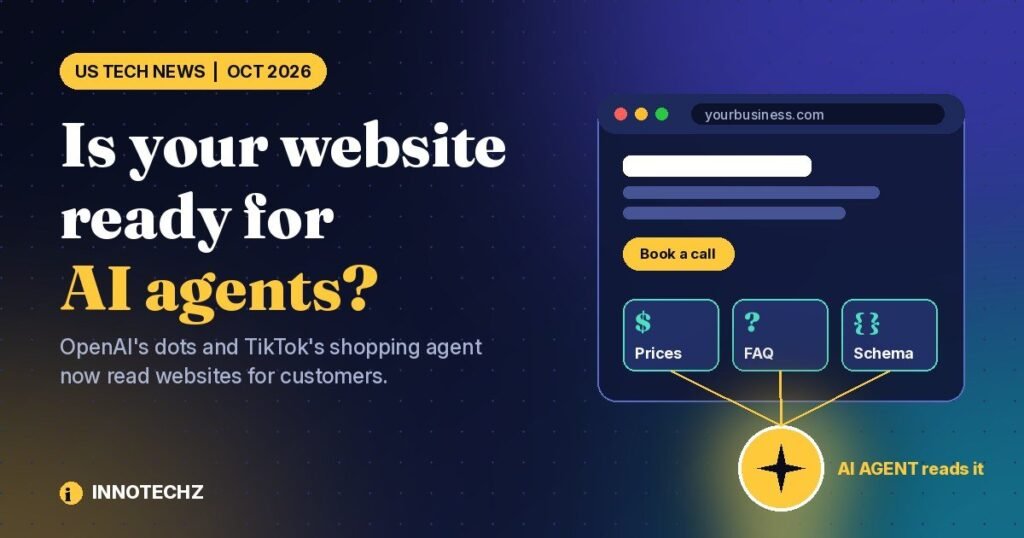
Two announcements from the United States in the past four weeks changed how I think about websites.
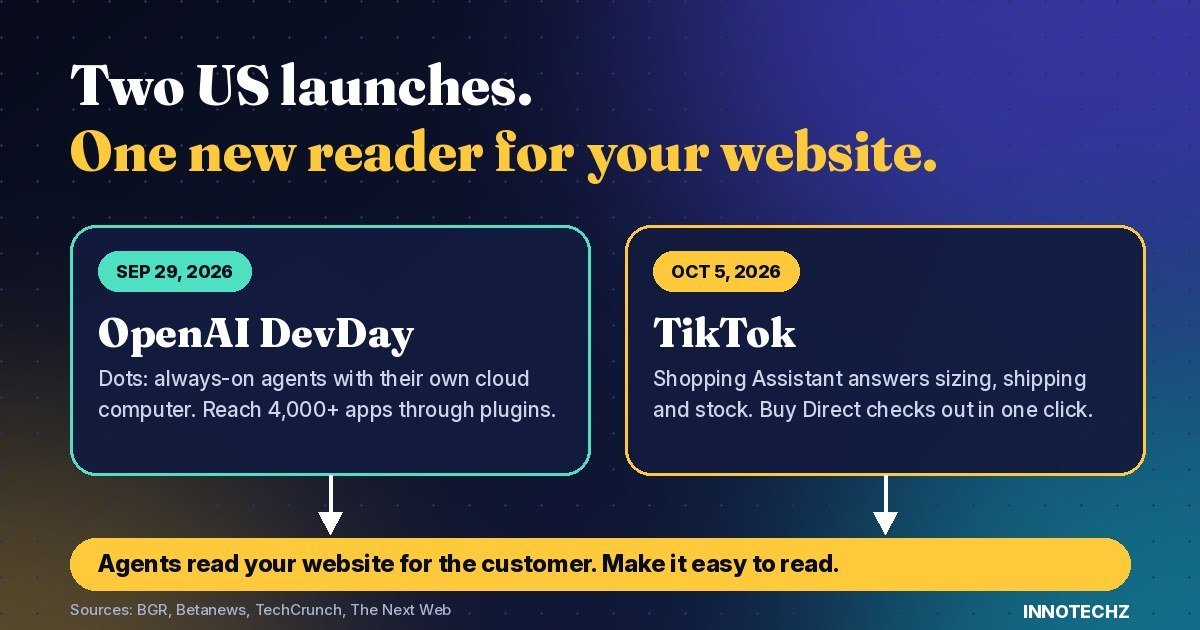
On September 29, OpenAI introduced dots, AI agents that keep working inside ChatGPT after you close the app. On October 5, TikTok announced a shopping assistant that answers product questions and then completes the purchase in the same app.
Both products do one thing. Software now acts for the customer. If that software cannot read your website, it will read a competitor’s. This guide is for business owners who sell to US customers.
Quick answer: An AI agent reads your website the way a new employee reads a company handbook. It needs plain-text answers, visible prices and terms, and structured data. To prepare, answer customer questions on the page, add schema markup, keep your business facts identical across the web, and test your brand by asking AI tools about it.
What happened in US tech news?
OpenAI held its DevDay conference in San Francisco on September 29, 2026. The main product was dots, always-on agents that use a dedicated cloud computer. BGR and Betanews both report that dots can reach more than 4,000 apps through OpenAI’s plugin system. OpenAI also introduced plugin extensions. These let developers build full apps inside ChatGPT, with a directory and in-chat recommendations, according to Every.
Availability is narrow today. BGR reports that dots go first to ChatGPT Pro 200 and Business Premium subscribers.
TikTok moved next. On October 5, the company announced Shopping Assistant and Buy Direct, as TechCrunch reported. The assistant answers questions about sizing, shipping and stock. Buy Direct lets a person buy from a brand in the For You feed with one click. TikTok gave no launch date, The Next Web notes.
The same TikTok announcement included Agentic Leads, an AI agent that talks with potential customers to qualify them as sales leads. NIQ data cited by The Next Web says more than half of US consumers now use AI for shopping.
Why does this matter for a small business website?
A person who asks an agent for “a web designer in Islamabad who builds WordPress sites” may never see ten blue links. They may see one answer and three names. Your website decides whether you are one of the three.
I do not know how fast this will spread. Dots need a paid plan, and TikTok has not set a date. Still, preparation costs little. A page that answers a question clearly also helps the human who lands on it.
TechRepublic makes a related point about TikTok’s checkout. Faster buying raises the value of accurate product details, stock updates, and clear delivery and return terms. I agree. A fast checkout does not fix a vague page.
What is the difference between SEO, AEO and GEO?
The three terms describe three audiences for the same page.
- SEO (search engine optimization) helps your pages rank in results on Google and Bing.
- AEO (answer engine optimization) shapes a page so a search feature can quote a short answer from it, such as a featured snippet or a voice reply.
- GEO (generative engine optimization) helps AI tools such as ChatGPT, Perplexity and Gemini name your business or cite your page when they write an answer.
The work overlaps heavily. A clear, accurate, well-structured page serves all three.
How do you prepare your website for AI agents?
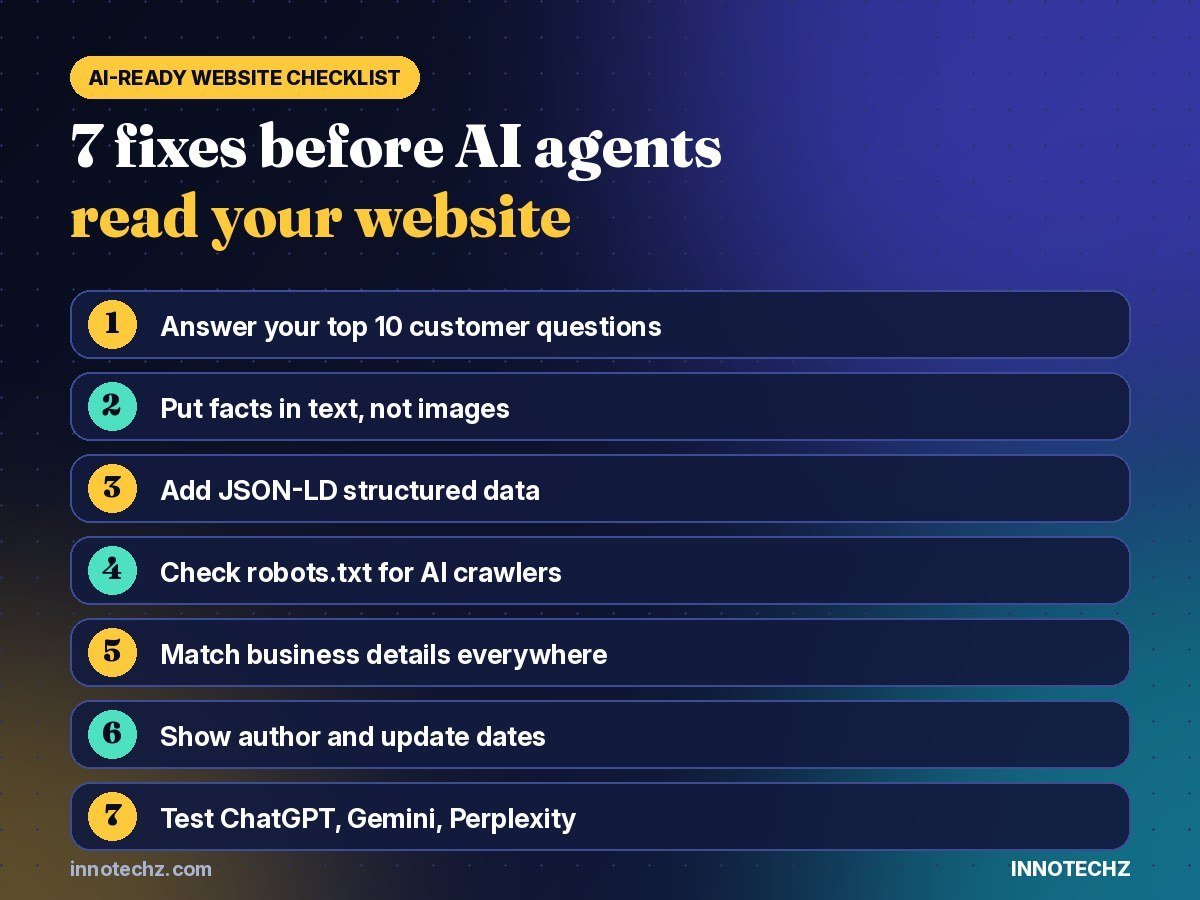
Seven changes cover most of it. None needs a rebuild.
- Write down the ten questions customers ask most. Answer each one in two or three plain sentences. Place the answer directly under a heading that repeats the question.
- Put facts in text, not in images. Prices, hours, service areas, delivery terms and return terms belong in the page text. Many systems cannot read a price list saved as a JPG.
- Add structured data. Use JSON-LD to label your Organization, Service or Product, Article and FAQ content. Labeled facts give a machine less to guess. Test the markup with Google’s Rich Results Test.
- Check your robots.txt file. Some security plugins and CDN settings block AI crawlers without telling you. Decide on purpose whether to allow them.
- Keep your business details identical everywhere. Use the same name, address, phone number and service list on your website, Google Business Profile, Yelp and LinkedIn. Mismatches confuse search engines and AI tools alike.
- Show who wrote each page and when. Add an author name, a publish date and an update date to every article. Change the date only when you change the content.
- Test the tools yourself. Open ChatGPT, Gemini and Perplexity. Ask the questions your customers ask. Record whether your business appears and what the answer says. Repeat every month.
What mistakes should you avoid?
Keyword stuffing still hurts. So does writing for machines only. A person decides whether to pay you, and a stiff page loses that person.
Hiding answers inside popups and tabs is another common error. If a visitor must click three times to find your price, an agent may not find it at all.
Chatbots deserve a warning too. A chatbot reads your pages. If the pages are thin, the answers are thin. Fix the pages first, then add the bot.
What should US businesses check first?
Local facts carry extra weight when a US shopper asks an AI tool for “a plumber near me” or “a web designer in Austin.” Check these five items before anything else.
- State your city, state and service area in page text, for example “serving Austin, Texas and nearby cities.”
- Show prices in US dollars and say whether sales tax is included.
- Write shipping times, return windows and warranty terms in plain text.
- Give business hours with a time zone, such as “9 a.m. to 5 p.m. Central Time.”
- Claim your Google Business Profile, fill in every field and answer your reviews.
What are we doing at INNOTECHZ?
INNOTECHZ is a web design, UI/UX, SEO and AI automation studio based in Rahim Yar Khan and Islamabad. From our studios, we build websites for businesses in the United States. We are redesigning our own website now.
Each service page will state what we do, who it is for and how we price it, in plain text. We are also adding a chatbot that answers from those same pages. If a page is wrong, the chatbot is wrong, so we correct the pages first.
If you want a second opinion on your own site, talk to INNOTECHZ about my website. You can also message us on WhatsApp at +92 334 4445604.
Frequently asked questions
What is an AI agent?
An AI agent is software that takes actions for a user, such as searching, comparing and buying. A chatbot only replies. OpenAI’s dots and TikTok’s Shopping Assistant are two agent products announced in the US in September and October 2026.
What is GEO in simple terms?
GEO stands for generative engine optimization. It means writing and structuring your pages so AI tools can understand your business and mention it accurately in their answers.
Do I need to rebuild my website for AI agents?
Probably not. Most sites need clearer pages, correct structured data and consistent business details. Rebuild only if the site is slow, hard to edit or hard to read on a phone.
Does this apply to local US businesses?
Yes. A local business should state its city, state, service area, hours and time zone in page text. Search engines and AI tools use those facts to match you with nearby customers.
Does SEO still matter?
Yes. Search engines still send visitors, and the same page quality feeds AI answers. Treat GEO as an extension of good SEO, not a replacement.
How long until AI tools mention my business?
Nobody can promise a date. AI tools update at different speeds, and none of them publish a schedule. Fix your pages, then test every month and record the results.
For twenty years, the machine reading your website was a search crawler, and most of us wrote for it only a little. Now that machine can also recommend, book and buy. Vague pages cost more than they used to.
Sources
- TechCrunch, “TikTok rolls out an AI shopping assistant and one-click checkout,” October 5, 2026: https://techcrunch.com/2026/10/05/tiktok-rolls-out-an-ai-shopping-assistant-and-one-click-checkout/
- The Next Web, “TikTok adds an AI shopping assistant and one-click checkout to its app”: https://thenextweb.com/news/tiktok-ai-shopping-assistant-buy-direct-checkout
- TechRepublic, “TikTok Unveils One-Click Checkout and AI Shopping Assistant”: https://www.techrepublic.com/article/news-tiktok-ai-shopping-assistant-one-click-checkout/
- BGR, “Everything OpenAI Announced At DevDay 2026”: https://www.bgr.com/2272332/openai-devday-2026-announcements/
- Betanews, “OpenAI launches dots, always-on ChatGPT agents with their own computers”: https://betanews.com/article/openai-dots-agents-chatgpt/
- Every, “Vibe Check: OpenAI DevDay 2026”: https://every.to/vibe-check/vibe-check-openai-devday-2026