AI Content Labeling Rules for Websites: A 2026 Guide
By Zahid Mehmood, Founder of INNOTECHZ. Published October 26, 2026. This guide gives general information and is not legal advice.
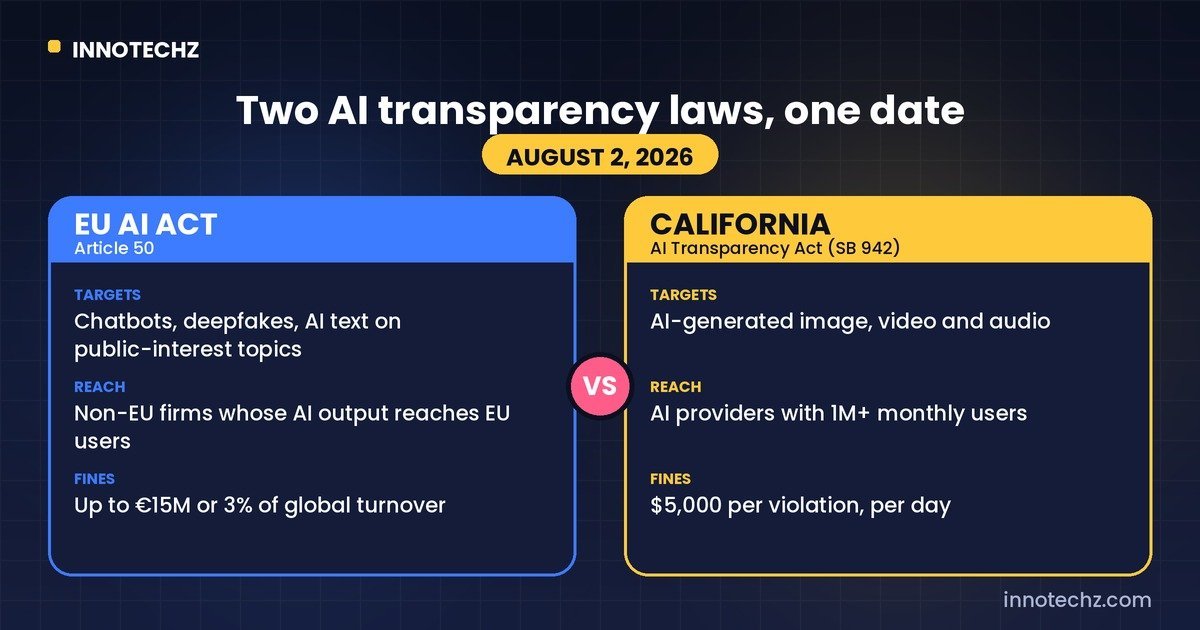
On August 2, 2026, the transparency rules in Article 50 of the EU AI Act became enforceable. On the same day, California’s AI Transparency Act became operative. Both laws ask one question. Can a person tell when AI made the thing in front of them?
Many business owners have not heard of either law. That is understandable. Most of the coverage comes from law firms, and it is dense. This guide explains the rules in plain words for owners in the US and abroad.
Quick answer: AI labeling rules ask websites to tell people when AI made an image, a video, a voice, a chatbot reply or a news-style article. The EU AI Act can reach businesses outside Europe when their AI output reaches EU users. California’s law targets large AI providers. To prepare, list your AI use, label realistic AI media, identify chatbots as AI, keep a named human editor over public-interest text, and record it all.
What happened in tech news this month?
Europe moved first. The European Commission adopted guidelines on Article 50 on July 20, 2026, and the duties became enforceable on August 2. Cooley reports that fines can reach €15 million or 3% of worldwide annual turnover, whichever is higher. The Commission says deepfakes and AI-generated text on matters of public interest need a clear label. It also says people must know when they talk to a chatbot.
Providers get some extra time. Baker Botts reports a grace period until December 2, 2026 for generative AI systems that were already on the market. During that time, those providers must add machine-readable marks to their output.
California followed on the same date. According to the National Law Review, its Act covers providers of generative AI systems with more than one million monthly visitors or users. The disclosure duties apply to image, video and audio content, not to text.
The news reached other regions too. On October 19, Germany signed an AI partnership with Nvidia at a summit in Berlin. Reuters reports that the deal sits inside Nvidia’s nearly $10 billion commitment to Europe. In the UK, the Financial Conduct Authority, the Bank of England and HM Treasury warned in May that frontier AI raises cyber risk for regulated firms, and the FCA followed with a review in September. I read this as one pattern. Governments now build AI capacity and write AI rules in the same year.
Do AI labeling rules apply to my website?
They can. Baker Botts says a company whose customer-facing chatbot or content tool reaches EU users falls under the rules, even without an EU office or servers. Faegre Drinker adds that the Commission takes a broad view of deepfake labeling. Posting content on the open internet may trigger the duty, even if you do not target the EU.
California works differently. The Act mainly binds large AI providers. GC AI notes that those providers must require their licensees by contract to keep the disclosure features intact. If you build on a covered model, check that your tools do not remove those features. An attorney-written guide on Terms.law lists penalties of $5,000 per violation per day for covered providers.
The US federal picture is unsettled. A December 2025 executive order told the Justice Department to challenge state AI laws, but the Cloud Security Alliance notes that the order does not itself override them.
My plain reading is simple. If you use AI to make visuals or chatbots, and visitors from Europe can see them, assume the EU rules touch you. Then ask a lawyer to confirm your case.
What must you label?
The rules name three situations.
- Chatbots: tell people they are talking to an AI system.
- Deepfakes: label realistic AI images, video or audio that could look authentic.
- AI text on public-interest topics: label it, unless a person reviewed it and takes editorial responsibility.
Two limits matter. Content generated before August 2, 2026 needs no retroactive label, according to the European Commission. Evidently artistic or fictional work gets a lighter rule. You disclose the AI use in a way that does not spoil the work.
Ordinary product descriptions are a different case from news-style or policy text. The line can blur, so ask a lawyer if you publish articles that inform the public on serious topics.
How do you prepare your website for AI labeling rules?
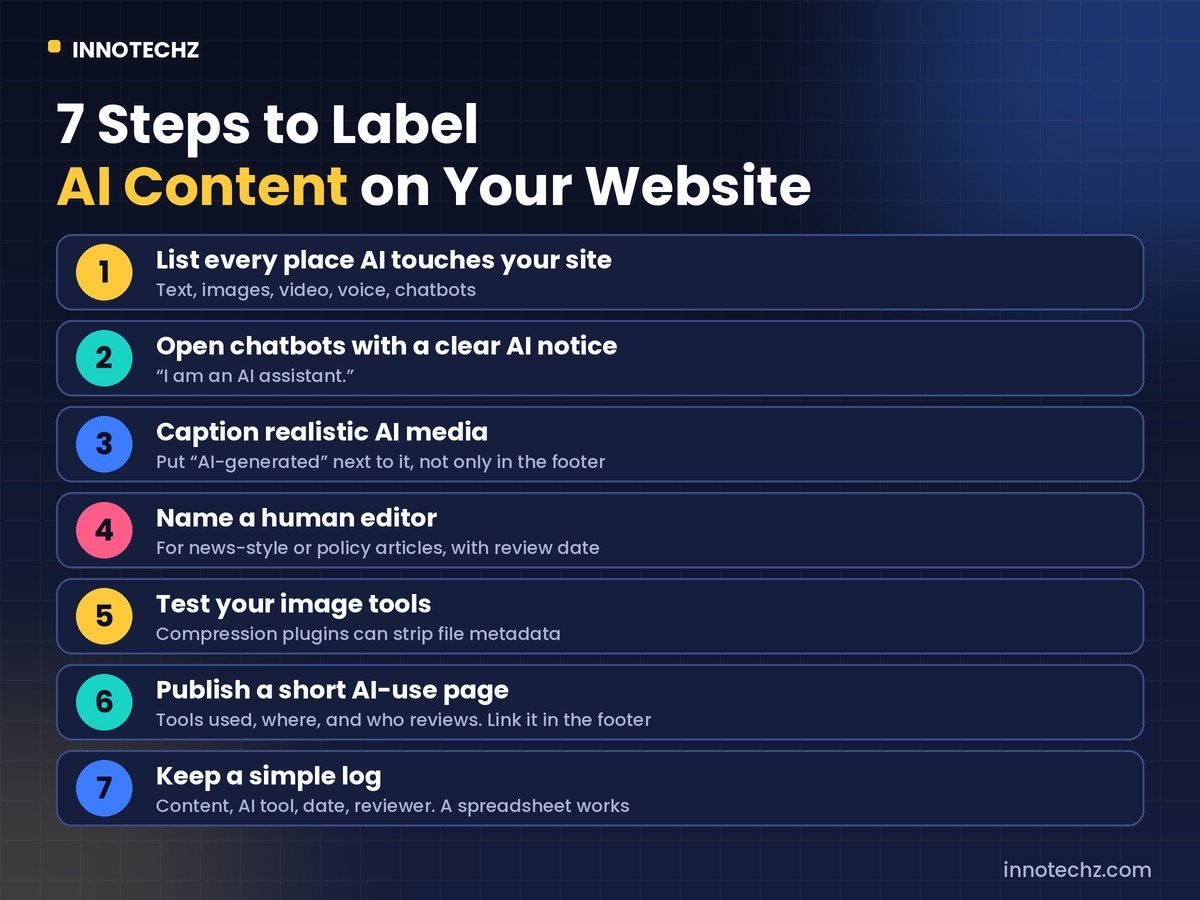
Seven steps cover most small sites.
- List every place AI touches your site. Include blog text, images, video, voice and chatbots.
- Open every chatbot with a clear first message, such as “I am an AI assistant.”
- Caption realistic AI images, video and audio with the words “AI-generated.” Place the label next to the media, not only in the footer.
- Name a human editor for news-style or policy articles. Record the editor’s name and the review date on the page.
- Test your image tools. Some compression plugins remove file metadata, which can erase provenance data. Run a test file through your workflow and compare the results.
- Publish a short AI-use page. State which tools you use, where you use them and who reviews the output. Link it from your footer.
- Keep a simple log with the content, the AI tool, the date and the reviewer. A spreadsheet is enough.
How do these rules affect SEO, AEO and GEO?
I found no source that says a label hurts rankings. I also cannot promise that it helps. What I can say is practical. An author name, an editor note and a clear AI-use page tell readers who stands behind a page. They also give search engines and AI tools a plain statement about how you work.
These are the same trust signals we covered in our guide on making a website ready for AI agents. Clear facts, named people and visible dates serve people and machines.
What are we doing at INNOTECHZ?
Our team uses AI tools for design, video and chatbots, so these rules apply to us. Here is the standard we are setting for our own site. We label AI-generated media next to the media. We name a human reviewer for each article. We are adding a short AI-use page to the redesigned website.
If you want a second opinion on your own site, talk to INNOTECHZ about my website. You can also message us on WhatsApp at +92 334 4445604.
Frequently asked questions
Do AI labeling rules apply to my US website?
They can. The EU AI Act reaches businesses outside Europe when their AI output reaches EU users, according to Baker Botts and Faegre Drinker. California’s law targets large AI providers, not most small sites.
Did the EU delay the AI Act transparency rules?
Not for most of Article 50. The Digital Omnibus delayed the high-risk AI duties, but the Article 50 transparency duties became enforceable on August 2, 2026, according to Goodwin and Ropes & Gray. The one extension covers machine-readable marking for generative AI systems already on the market. Those providers now have until December 2, 2026.
Do I need to label every AI-written blog post?
Not under the Article 50 duty as law firms describe it. The text duty covers AI-generated text published to inform the public on matters of public interest. It does not apply when a person reviews the text and takes editorial responsibility. Rules differ by case, so ask a lawyer.
What are the penalties under the EU AI Act?
Cooley reports fines of up to €15 million or 3% of worldwide annual turnover, whichever is higher, for breaking the Article 50 duties.
Do I need to relabel content I published before August 2026?
No. The European Commission states that content generated before August 2, 2026 does not need a retroactive label.
What should a chatbot disclosure say?
Keep it short and plain. For example: “I am an AI assistant. A person on our team can also help you.” Show it in the first message, before the visitor types anything.
Is this legal advice?
No. This article gives general information from public sources. A lawyer who knows your country and your business can confirm what applies to you.
Rules will differ by country and they will keep changing. The habit stays the same. Tell people when AI made something, and keep a named person responsible for what you publish.
Sources
- Cooley, “EU AI Act: Transparency Obligations Take Effect 2 August 2026”: https://www.cooley.com/news/insight/2026/2026-08-03-eu-ai-act-transparency-obligations-take-effect-2-august-2026
- Baker Botts, “EU AI Act Article 50 Transparency Obligations Go Live,” September 2026: https://www.bakerbotts.com/thought-leadership/publications/2026/september/eu-ai-act-article-50-transparency-obligations-go-live
- Faegre Drinker, “EU AI Act: Commission Confirms Transparency Code of Practice as Adequate,” July 2026: https://www.faegredrinker.com/en/insights/publications/2026/7/eu-ai-act-commission-confirms-transparency-code-of-practice-as-adequate-and-publishes-final-version-of-its-guidelines-on-transparency-obligations
- European Commission, “Signing the Code of Practice on Transparency of AI-generated Content”: https://digital-strategy.ec.europa.eu/en/faqs/signing-code-practice-transparency-ai-generated-content
- European Commission, “Commission publishes Code of Practice on marking and labelling AI-generated content”: https://digital-strategy.ec.europa.eu/en/news/commission-publishes-code-practice-marking-and-labelling-ai-generated-content
- National Law Review, “Key Deadlines Under the California AI Transparency Act”: https://natlawreview.com/article/californias-ongoing-ai-regulation-key-deadlines-arriving-2026-and-beyond
- GC AI, “State AI Laws in 2026: SB 53, SB 942, and Preemption”: https://gc.ai/blog/state-ai-laws
- Reuters via The Star, “Germany’s Merz urges AI investment ahead of Nvidia deal,” October 20, 2026: https://www.thestar.com.my/tech/tech-news/2026/10/20/germany039s-merz-urges-ai-investment-ahead-of-nvidia-deal
- Goodwin via Mondaq, “Not Delayed, Not Deferred: EU AI Act Transparency Obligations Are Now in Force,” August 2026: https://www.mondaq.com/uk/compliance/1826042/not-delayed-not-deferred-eu-ai-act-transparency-obligations-are-now-in-force
- Ropes & Gray, “You talkin’ to me? Operationalising the EU AI Act’s transparency obligations,” August 2026: https://www.ropesgray.com/en/insights/viewpoints/2026/08/102nfqm/you-talkin-to-me-operationalising-the-eu-ai-acts-transparency-obligations
- Terms.law, “California AI Laws (2026): The Complete Business Guide”: https://terms.law/california-ai-laws/
- Cloud Security Alliance, “State AI Laws Take Hold as Federal Preemption Stalls,” April 2026: https://labs.cloudsecurityalliance.org/research/csa-research-note-us-ai-regulation-preemption-compliance-202/
- Baker McKenzie, “United Kingdom: FCA reinforces supervisory expectations for frontier AI,” May 2026: https://www.bakermckenzie.com/en/insight/publications/2026/05/united-kingdom-fca-reinforces-supervisory-expectations-for-frontier-ai
- Regulation Tomorrow, “FCA multi-firm review: frontier AI and cyber resilience,” September 2026: https://www.regulationtomorrow.com/2026/09/fca-multi-firm-frontier-ai-and-cyber-resilience/