AI Data Center Backlash: Why Voters Said No as Google Bets $17 Billion on Wyoming
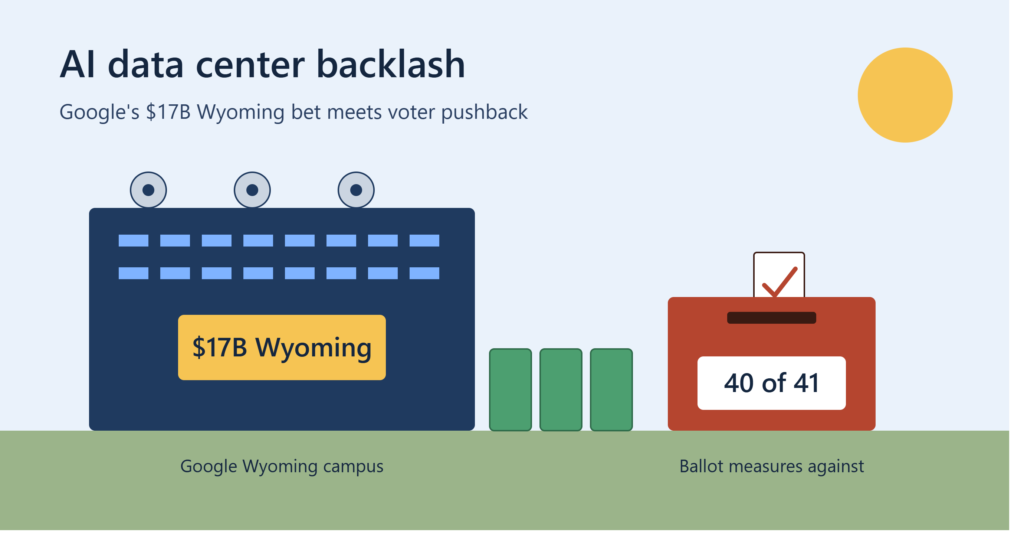
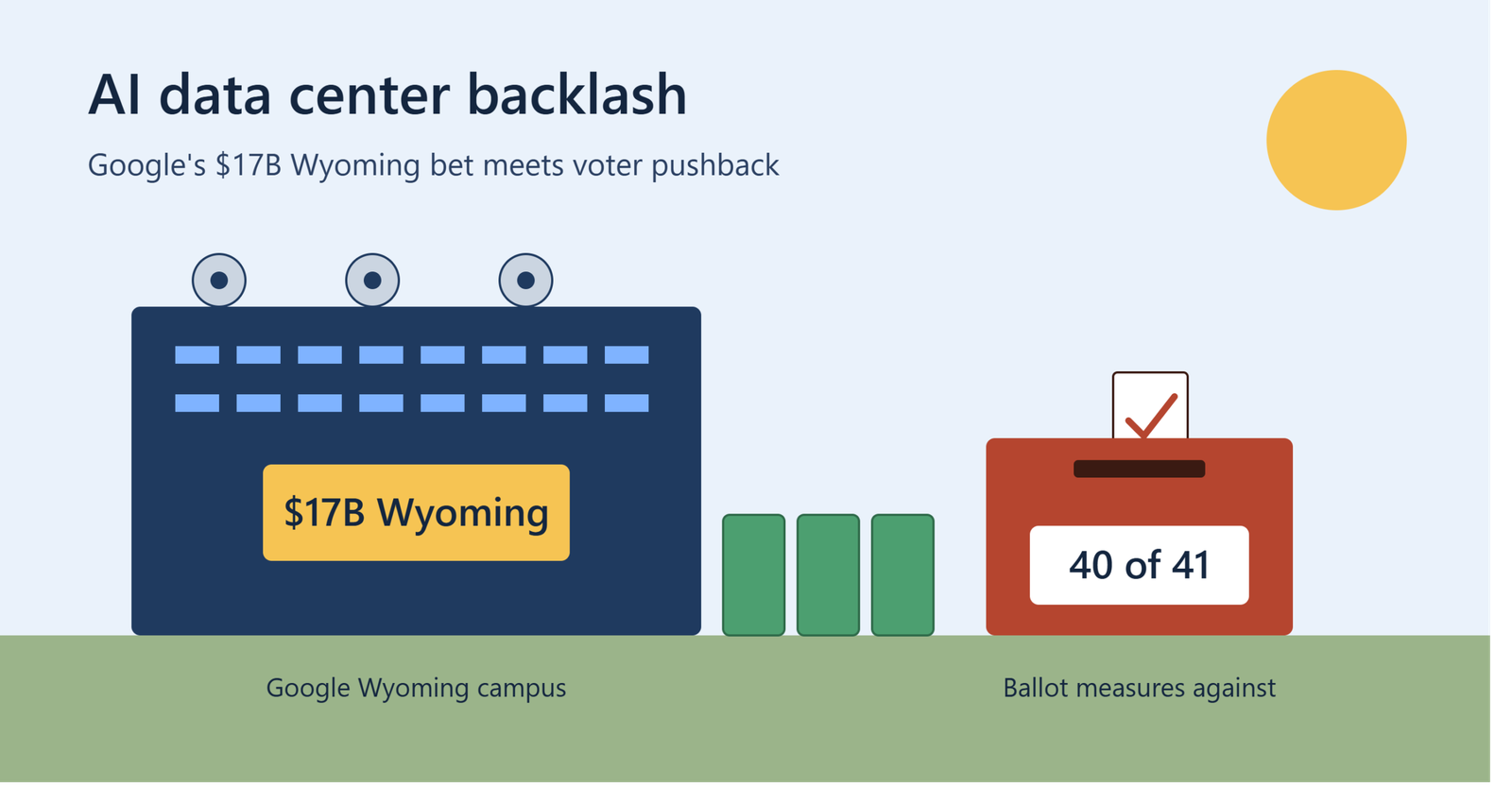
Quick answer: why are people pushing back on AI data centers? Large AI data centers use a lot of electricity, water and land. Residents in the US worry about higher power bills, strained grids and few permanent jobs. In early November 2026, voters backed limits on data centers in 40 of 41 related ballot measures, according to Ballotpedia. In the same week, Google announced a $17 billion data center in Wyoming.
Key Takeaways
- Google confirmed on November 5, 2026 that it will invest $17 billion in its first Wyoming data center, in Laramie County near Cheyenne.
- Ballotpedia counted 40 of 41 data center ballot measures going against data centers in the same week.
- Google says it will pay for 100% of the power the site uses and will cool it with air, not water.
- The power plan uses natural gas fuel cells with carbon capture, which supporters and critics will both debate.
- The pushback is not only American. Finnish police opened a probe into Google’s land clearing for a data center there.
- Businesses that rely on AI tools should expect higher scrutiny, slower builds and more focus on energy cost.
What Did Google Announce in Wyoming?
On November 5, 2026, Google said it will build its first data center in Wyoming. The company put the investment at $17 billion. The campus will sit in Laramie County, close to Cheyenne.
Google is building the project with Tallgrass Energy, Black Hills Energy, American Electric Power (AEP) and Related Digital. Google also acquired the site from Crusoe, the AI infrastructure developer that first worked on it with Tallgrass.
The power plan stands out. AEP will supply about 702 megawatts from Bloom Energy fuel cells. The fuel cells run on natural gas. Most of the carbon emissions will go to Tallgrass’s nearby sequestration hub for underground storage.
Google says the facility will create over 3,700 jobs a year once it runs, including about 250 direct roles. Those numbers matter, because job counts are a central point in the local debate.
Why Did Voters Reject So Many Data Center Projects?
The vote came just before Google’s announcement. Ballotpedia counted 41 data center ballot measures in the US that week. All but one went against data centers. Reuters also noted that some midterm winners in Texas and Georgia ran on slowing data center growth.
Three concerns come up again and again:
- Electricity. Large campuses can strain local grids. Residents ask who pays for new power lines and plants.
- Water and land. Cooling systems and large sites change local land and water use.
- Jobs. A campus costs billions to build, but it needs only a small permanent staff.
The result is a new kind of AI risk. The risk is not only model quality or chip supply. It is public permission to build the physical systems that AI needs.
How Is Google Responding to the Concerns?
Google’s Wyoming plan reads like a direct answer to the three concerns above:
- Power cost: Google says it will pay for 100% of the power it uses.
- Water: Google says the site will be air-cooled to limit stress on local water.
- Emissions: The fuel cells include carbon capture, with storage nearby.
Critics may still point out that the fuel cells burn natural gas, and that carbon capture projects depend on delivery over many years. Supporters will point to the investment, the jobs and the funding of new power supply. Both views are fair. The key point is that big tech companies now treat energy and community terms as part of the product plan.
Is the AI Data Center Backlash Only a US Issue?
No. In Finland, police recently opened a criminal probe into Google’s clearing of forest land for a data center. The question is whether the work started before the legally required environmental review was done.
There are also signs of caution inside the industry. Bloomberg reported that Microsoft declined to expand a Texas data center agreement with AI cloud provider Nscale. One decision does not make a trend. Still, it shows that companies are checking how fast they expand.
For readers in Europe, the Middle East and South Asia, the lesson is similar. Countries that want AI investment will need clear rules on power, water and land. Countries that supply cheap clean power may gain an edge.
What Does This Mean for Businesses and Website Owners?
Most companies will never build a data center. They still buy the output: cloud hosting, AI tools, video generation and chat features. Here is what to watch.
- Cloud and AI costs may rise. Limits on new capacity and higher power costs can push prices up over time. This is a risk, not a certainty.
- Plan for efficiency. Smaller models, caching and lighter pages cost less to run. They also load faster for users.
- Do not depend on one provider. Keep your content, designs and data portable.
- Be clear about AI use. Users are showing less patience with AI features they cannot control. Give people choices.
- Think regionally. Hosting close to your customers helps speed. It also helps with data rules in the US, the EU and South Asia.
Frequently Asked Questions
How much is Google investing in its Wyoming data center?
Google announced a $17 billion investment on November 5, 2026. It is the company’s first data center in Wyoming.
Where is the Google data center in Wyoming?
It is in Laramie County, near Cheyenne, in the southeast of the state.
How will the Wyoming data center be powered?
AEP plans to supply about 702 megawatts from Bloom Energy fuel cells that run on natural gas. Most carbon emissions will be captured and stored at a nearby Tallgrass sequestration hub. Google says it will pay for all the power it uses.
Why did voters oppose data centers in November 2026?
Residents are concerned about electricity demand, water and land use, and the small number of permanent jobs. Ballotpedia counted 40 of 41 data center ballot measures going against data centers that week.
Will the data center backlash raise the price of AI tools?
It may, over time. Fewer or slower builds and higher power costs can raise cloud prices. No one can say by how much yet.
Is the data center backlash happening outside the US?
Yes. Finnish police opened a probe into Google’s land clearing for a data center there, which shows that local pushback is global.
Final Thoughts
The AI race now runs through town halls and ballot boxes, not only labs and chip factories. Google’s Wyoming plan shows one possible answer: pay for the power, save water and capture the carbon. Whether voters accept that answer is still open.
At INNOTECHZ, we build fast, efficient websites and AI-ready digital products for clients in the USA, the UK, the Middle East and Pakistan. If you want a website or AI video workflow that stays fast and cost-aware as the market changes, start my project with INNOTECHZ today.
Sources: Google blog post by Steve Walter (Nov 5, 2026); Reuters; Ballotpedia; Bloomberg; Baxtel; Silicon UK; Finimize; YourStory. This article is for information only. Details may change as the project and the political debate develop.