
GPT-6.1 Terra Is 50% Cheaper: What Small Businesses Should Automate First in 2026
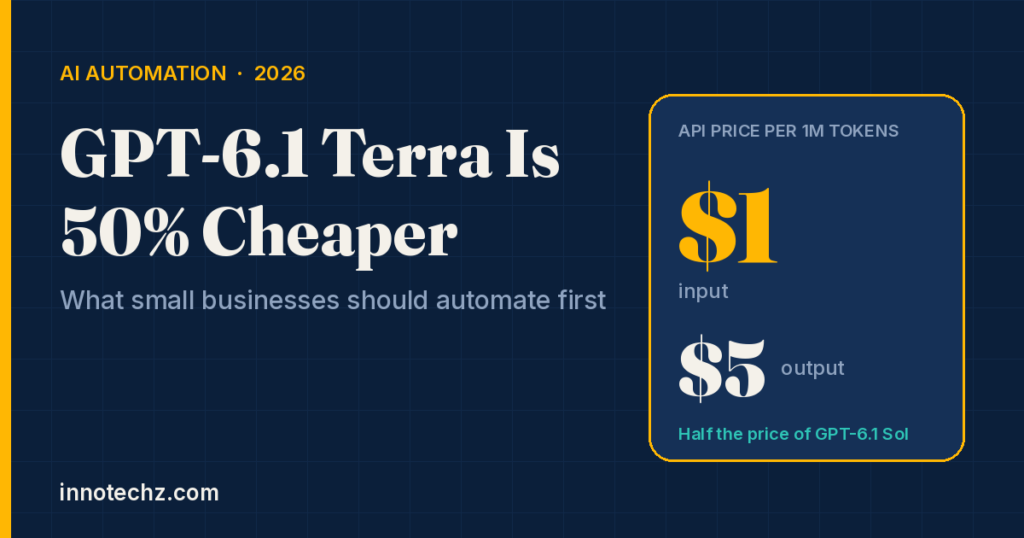
GPT-6.1 Terra is OpenAI’s new mid-tier AI model, released on October 26, 2026, and it costs half as much as GPT-6.1 Sol: $1 per million input tokens and $5 per million output tokens. Our view at INNOTECHZ is simple. The model matters less than the math. When AI gets this cheap, the question stops being “can we afford automation?” and becomes “which boring task do we hand over first?”
Key takeaways
- GPT-6.1 Terra costs $1 / $5 per million tokens (input / output), with cached input at $0.05.
- OpenAI says that is 50% lower than GPT-5.6 Terra and GPT-6.1 Sol.
- It is aimed at computer use, visual reasoning, forms and drafting, not the hardest coding.
- A typical document task can cost pennies, but screen-based work uses more tokens, so pilot first.
- Start with high-volume, low-risk, easy-to-check tasks.
What is GPT-6.1 Terra?
GPT-6.1 Terra is a reasoning model from OpenAI that sits between its cheaper GPT-6 Luna and its more capable GPT-6.1 Sol and GPT-6 Astra. It takes text, images and files as input and gives text back. The context window is about 1.05 million tokens, so it can hold a lot of paperwork in one go.
The practical bit: it can look at a screen, understand what it sees and act on it. OpenAI’s own example is reading incoming invoices and typing the details into accounting software. That is exactly the kind of dull, repetitive job that eats a small team’s week.
You can use it in ChatGPT Work and Codex on Plus, Pro, Enterprise and Edu plans. Developers can call it through the OpenAI API as gpt-6.1-terra.
How much cheaper is GPT-6.1 Terra?
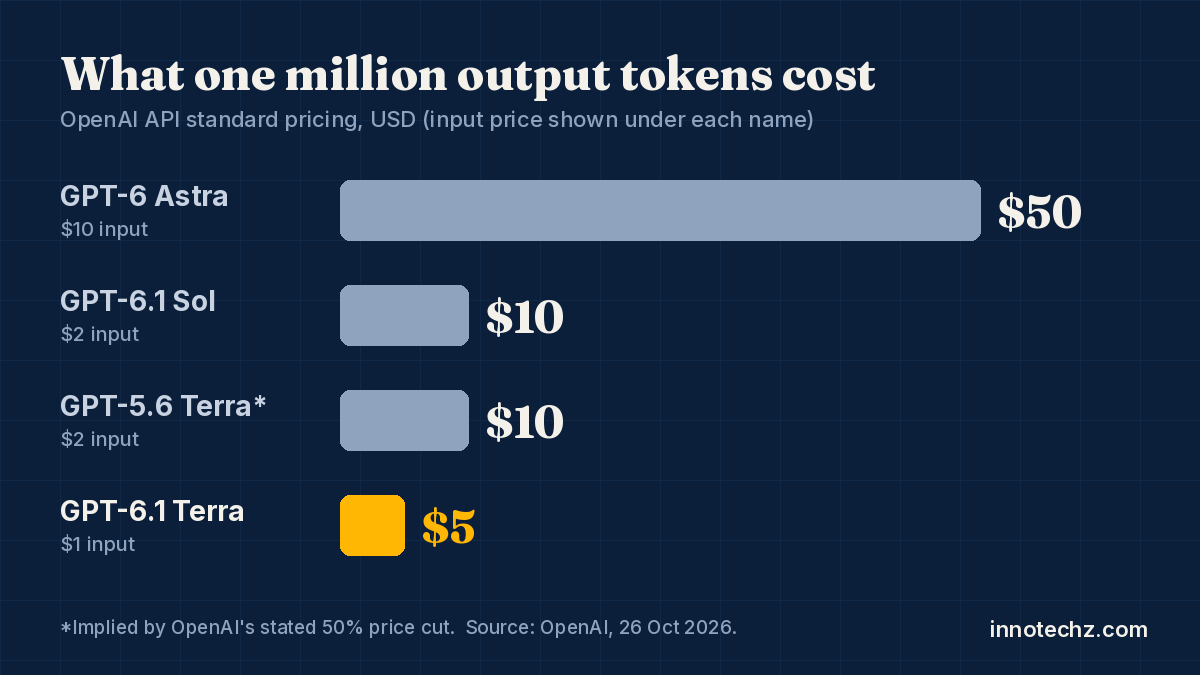
Half. OpenAI says Terra’s standard API prices are 50% lower than both GPT-5.6 Terra (which it replaces) and GPT-6.1 Sol. Here is the before-and-after picture, per million tokens:
| Model | Input | Output | Best for |
|---|---|---|---|
| GPT-6.1 Terra | $1 | $5 | Screens, forms, drafting, visual tasks |
| GPT-5.6 Terra (replaced)* | about $2 | about $10 | Previous mid-tier model |
| GPT-6.1 Sol | $2 | $10 | Harder coding and reasoning |
| GPT-6 Astra | $10 | $50 | The hardest research problems |
*Implied by OpenAI’s stated 50% cut. Prices are OpenAI’s standard API rates as of October 2026 and can change.
What does that look like in real money?
Take one invoice-sized job: 20,000 input tokens in, 5,000 tokens out. At Terra’s standard rates that’s $0.02 for input plus $0.025 for output, so about $0.045. Run 1,000 of them and you’re at roughly $45.
Now the honest part. Jobs that involve screenshots, browsing and several steps use far more tokens than a single document, and tool calls can add their own charges. OpenAI’s own benchmark of professional tasks put Terra at about $1.01 per task at maximum effort, against $3.58 for GPT-5.6 Terra. Those are vendor-reported numbers, so treat them as a guide and test on your own work. If a job isn’t urgent, batch and flex pricing can cut the bill by around half again, according to third-party model listings.
What should small businesses automate first?
Our rule of thumb: pick work that is high volume, rule-based and easy for a human to check in seconds. If a mistake would be expensive or hard to spot, it’s not a first project.
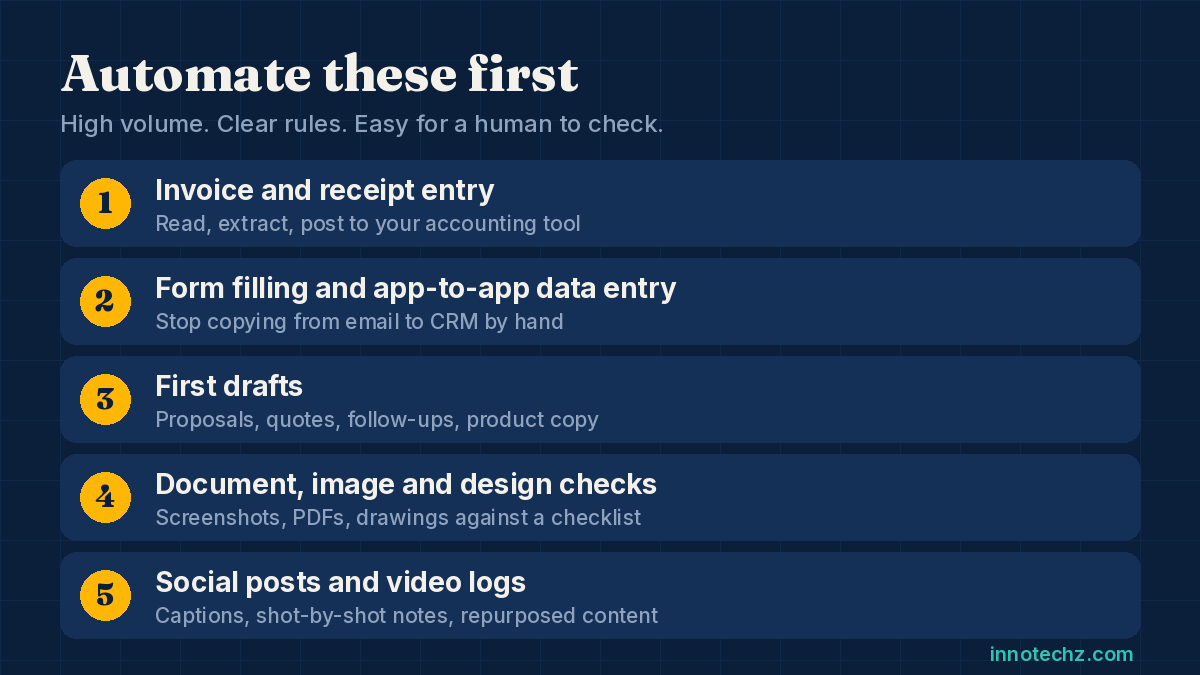
- Invoice and receipt entry. Read the document, pull out supplier, date and amount, and post it to your accounting tool. A person approves the batch.
- Form filling and app-to-app data entry. Copying details from emails into a CRM or spreadsheet is the classic time sink.
- First drafts. Proposals, quotes, follow-up emails and product descriptions. The AI writes version one, you make it sound like you.
- Document, image and design checks. Compare a PDF, screenshot or mockup against a checklist before it goes to a client.
- Social posts and video logs. OpenAI’s own examples include building a time-coded, shot-by-shot log from footage, which is handy for marketing and content teams.
What to leave alone for now
Payment approvals, legal or medical advice, and anything customer-facing that goes out without review. OpenAI also says Sol or Astra are the better picks for the most complex coding, so don’t swap every workflow to Terra because of one benchmark.
Can you trust it?
Better than before, but not blindly. On an internal test of error-inducing prompts, OpenAI reports Terra’s error rate at low reasoning effort fell from 53.6% with GPT-5.6 Terra to 16.7%. That’s a real improvement and still not zero. Keep a human in the loop, especially for money, contracts and customer messages.
Is GPT-6.1 Terra the cheapest AI model for business?
No, and it doesn’t try to be. OpenAI has a cheaper GPT-6 Luna for simple jobs, and other providers price their models differently. Terra’s pitch is value: strong computer-use and visual skills at a mid-tier price. “Cheapest” depends on the task, so compare cost per finished task, not just the price per token.
A simple 30-day plan to get started
- Week 1: Pick one task. Choose something you do at least 50 times a month.
- Week 1: Measure it. Note how many minutes it takes and how often it goes wrong today.
- Weeks 2 and 3: Pilot with a human check. Run the AI on real examples and review every output.
- Week 4: Decide. Compare time saved and error rate. If it wins, scale it. If not, tweak the instructions or try another model tier.
Once it works, route tasks by difficulty: cheaper models for volume, stronger ones for the hard cases. That’s how you keep the bill low as you grow.
The INNOTECHZ take
Cheaper models don’t magically fix a messy process. They just make it affordable to try. The businesses that win in 2026 will be the ones that pick one clear task, measure it honestly and expand from there. If you’d like help finding that first task, or building and testing the automation, talk to our team.
Frequently asked questions
What is GPT-6.1 Terra?
GPT-6.1 Terra is OpenAI’s mid-tier AI model, released on October 26, 2026. It is built for computer use, visual reasoning, writing and everyday office work. It replaces GPT-5.6 Terra and is available in ChatGPT Work, Codex and the API as gpt-6.1-terra.
How much cheaper is GPT-6.1 Terra?
OpenAI says standard API prices are 50% lower than both GPT-5.6 Terra and GPT-6.1 Sol. That means $1 per million input tokens, $0.05 per million cached input tokens and $5 per million output tokens.
Is AI automation affordable for small businesses?
Yes, for the right tasks. At Terra’s prices, a request with 20,000 input tokens and 5,000 output tokens costs about $0.045, or roughly $45 per 1,000 requests. Real costs run higher for screen-based work, so run a small pilot first.
What should a small business automate first?
Start with high-volume, rule-based work that a person can check quickly: invoice entry, form filling, first drafts of proposals and emails, document and design checks, and social or video content logs.
Is GPT-6.1 Terra the cheapest AI model for business?
Not necessarily. OpenAI has cheaper models below Terra for simple tasks, and other providers price differently. Terra’s appeal is value: strong computer-use and visual skills at a mid-tier price. The cheapest option depends on the job.
Should I use Terra or Sol?
Use Terra for high-volume screen, form, document and drafting work. OpenAI says Sol and GPT-6 Astra remain the better choice for the most complex coding and hardest reasoning tasks.
Sources
- OpenAI: Introducing GPT-6.1 Terra
- InfoWorld: OpenAI bets on AI economics with lower-cost GPT-6.1 Terra
- MarkTechPost: GPT-6.1 Terra launch coverage
- gHacks: GPT-6.1 Terra pricing
Pricing and benchmark figures come from OpenAI and third-party reports published October 26 to 28, 2026. Check OpenAI’s pricing page before you budget.