
NIST Post-Quantum Deadlines: What Small Business Websites Should Do Before 2030
NIST says quantum-vulnerable encryption, including RSA and elliptic-curve cryptography, will be deprecated after 2030 and disallowed after 2035. The final version of NIST IR 8547 landed on October 27, 2026. Our take at INNOTECHZ: if you run a small business website, there’s no need to panic or buy anything exotic today. But you do need a plan, because the cheapest fixes (updates, TLS 1.3, a modern CDN) are ones you can start this month.
Key takeaways
- 2030 and 2035: NIST will deprecate quantum-vulnerable public-key cryptography after 2030 and disallow it after 2035.
- HTTPS is safe today. The risk is future quantum computers and “harvest now, decrypt later” attacks.
- Browsers are ahead of servers. Chrome, Edge, Firefox and Apple devices already offer hybrid post-quantum key exchange. Your server or CDN has to say yes.
- No quantum-proof certificate to buy yet. Be wary of anyone selling one.
- Start small: inventory, TLS 1.3, post-quantum at the edge, updates, less data, vendor questions.
What are NIST’s 2030 and 2035 deadlines?
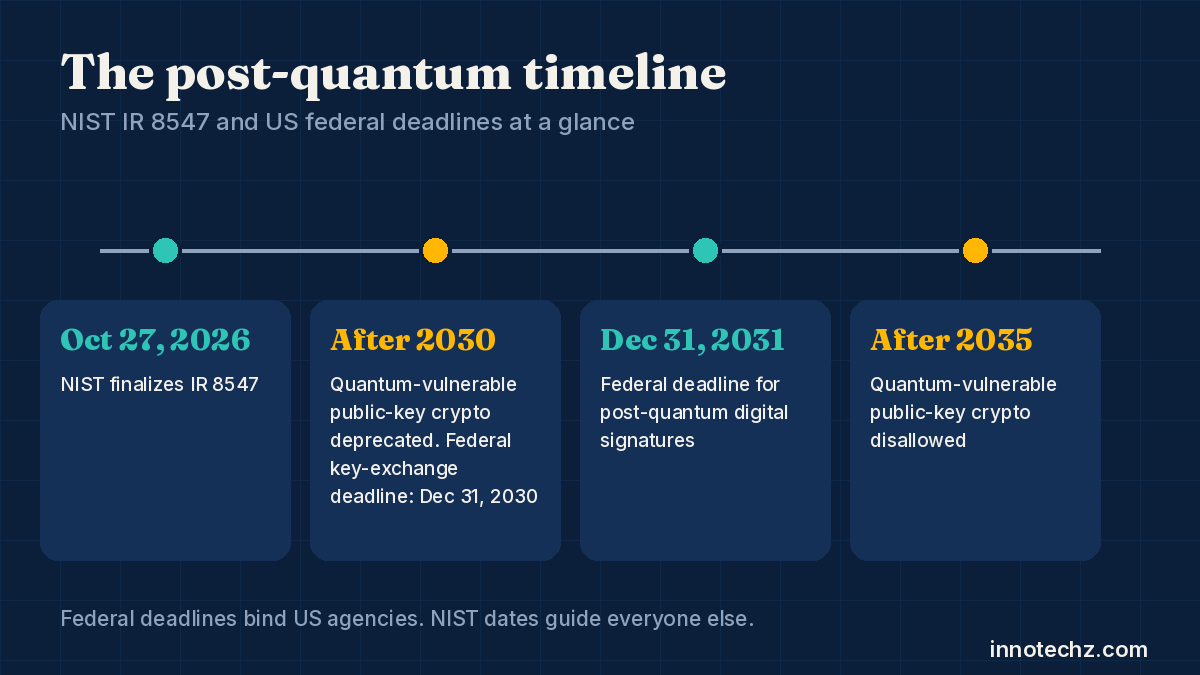
Short answer: NIST will deprecate quantum-vulnerable public-key cryptography after 2030 and disallow it after 2035. That covers the algorithms behind most of today’s secure web: RSA, elliptic-curve Diffie-Hellman and ECDSA. NIST’s report, NIST IR 8547, lays out the plan and points to the post-quantum standards NIST published in 2024 (FIPS 203, 204 and 205).
| Date | What happens | Who it applies to |
|---|---|---|
| Oct 27, 2026 | NIST publishes final IR 8547 | Guidance for everyone |
| Dec 31, 2030 | Quantum-resistant key establishment due on high-value and other priority systems | US federal agencies (EO 14412, OMB M-26-15) |
| After 2030 | Quantum-vulnerable public-key cryptography deprecated | NIST standards and guidelines |
| Dec 31, 2031 | Post-quantum digital signatures due | US federal agencies |
| After 2035 | Quantum-vulnerable public-key cryptography disallowed | NIST standards; 2035 is also the federal goal under NSM-10 |
Two words matter here. Deprecated means you can still use the algorithm, but you’re expected to assess the risk and decide whether to keep going. Disallowed means it’s off the table. Summaries of the final report differ on exactly which key sizes are deprecated when, so read the report itself before you write a compliance policy.
Does NIST IR 8547 apply to my small business?
Not directly. The hard deadlines are for US federal agencies. If you run a local bakery site or a design portfolio, nobody is coming to audit you in 2030.
Still, this isn’t only a government story. NIST guidance has a habit of trickling into vendor contracts, procurement checklists and the security questionnaires bigger customers send you. If you work with US federal contractors, healthcare, finance or enterprise clients, expect questions about your cryptography sooner than 2030. The same goes for international clients, since many countries are running similar migration plans.
Is HTTPS safe from quantum computers?
Today, yes. Large-scale quantum computers that can break today’s encryption don’t exist yet. Nobody can say exactly when they will, which is why NIST is planning years ahead rather than waiting.
It helps to split HTTPS into three parts:
- Bulk encryption (AES). The part that scrambles your actual page data. It’s considered fine against quantum attacks with strong key sizes.
- Key exchange (RSA or elliptic curves). How your browser and server agree on a secret. This is the part a future quantum computer could break. It’s also where the industry has moved fastest, using a hybrid method called X25519MLKEM768 that combines a classic algorithm with the new ML-KEM standard.
- Certificate signatures (RSA or ECDSA). How your browser knows the site is really yours. Post-quantum signatures are still being rolled out for the public web.
Adoption on the visitor side is strong. Chrome and Edge 131+, Firefox 132+ and recent Apple systems support hybrid post-quantum key exchange, and Cloudflare reported that more than two-thirds of human web traffic to its network used it by April 2026. The server side is slower. Cloudflare measured only about 10% of its customers’ origin servers supporting it in February 2026.
Why “harvest now, decrypt later” matters
Picture someone photocopying your locked diary today and waiting for a key to be invented. That’s the idea. Attackers can record encrypted traffic now and decrypt it once quantum computers mature.
So the real question is how long your data needs to stay secret. A brochure website has little to lose. A site that collects ID documents, medical details, legal files or financial records has plenty. The longer the shelf life of the data, the sooner this matters.
Does my website need quantum-safe encryption now?
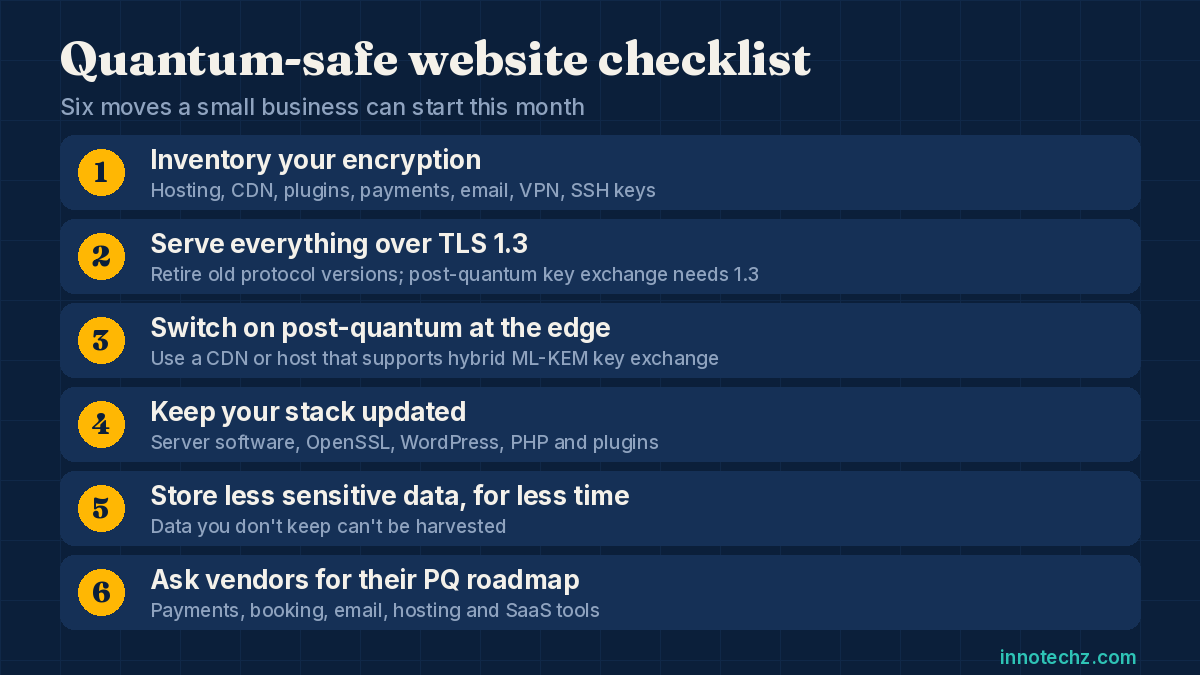
You don’t need a rebuild, and you can’t buy a perfect “quantum-safe” setup off the shelf. What you can do is make your site quantum-ready: modern protocols, an up-to-date stack and a provider that’s moving in the right direction. Here are six steps, in order of effort.
6 steps to prepare your website before 2030
- Inventory your encryption. List where your site and business use public-key cryptography: hosting, CDN, WordPress plugins, payment processors, email, VPN and SSH keys. You can’t fix what you haven’t found.
- Serve everything over TLS 1.3. Post-quantum key exchange in browsers works over TLS 1.3. Turn off old protocol versions and make sure your host supports 1.3.
- Turn on post-quantum at the edge. The easiest route is a CDN or host that already supports hybrid post-quantum key exchange. Cloudflare has offered it to visitors for years, and reports say Google Cloud load balancers are starting to enable it by default. Ask your host, don’t assume.
- Keep your stack updated. Newer server software and libraries (OpenSSL 3.5 and later, for example) support hybrid post-quantum groups. Update WordPress, PHP and plugins too. Outdated software is a bigger risk today than any quantum computer.
- Store less sensitive data, for less time. Data you don’t keep can’t be harvested. Review what forms collect, delete what you don’t need and set retention limits.
- Ask your vendors. Payment gateways, booking tools, email providers and SaaS apps all hold your customers’ data. Ask each one for their post-quantum roadmap and add it to your renewal checklist.
A quick way to test your server
If you or your developer has OpenSSL 3.5 or newer, you can check whether a server accepts the hybrid group. This tests the server that answers the request, so if you use a CDN, you’re testing the CDN.
openssl s_client -connect yourdomain.com:443 -groups X25519MLKEM768 -briefIf the handshake completes, that server speaks hybrid post-quantum key exchange. If it fails, ask your host or CDN what’s on their roadmap.
What not to do
- Don’t buy a “quantum-proof SSL certificate.” To our knowledge, post-quantum certificates aren’t yet available for general use on the public web.
- Don’t write your own encryption. Use well-tested libraries and providers.
- Don’t wait until 2029. Migrations always take longer than planned.
A realistic timeline for a small business
- 2026 to 2027: inventory, TLS 1.3, update software, ask your host and CDN about post-quantum support.
- 2028 to 2029: check vendor roadmaps, plan for post-quantum certificates as browsers and certificate authorities roll them out.
- 2030: NIST begins deprecation. Make sure nothing critical depends on a single quantum-vulnerable algorithm.
- By 2035: quantum-vulnerable public-key cryptography is disallowed under NIST standards.
The INNOTECHZ take
Quantum computing sounds like science fiction, which makes it easy to ignore. But this migration is happening quietly and it’s mostly a maintenance job: keep software current, choose providers that keep up, and don’t hoard data you don’t need. Do that and you’ll be most of the way there before the deadlines arrive. If you’d like help auditing your website’s security setup or moving to a modern host, talk to our team.
Frequently asked questions
What are NIST’s 2030 and 2035 post-quantum deadlines?
NIST will deprecate quantum-vulnerable public-key cryptography, such as RSA and elliptic-curve algorithms, after 2030 and disallow it after 2035. US federal agencies face earlier deadlines: December 31, 2030 for key establishment on priority systems and December 31, 2031 for digital signatures.
Does my website need quantum-safe encryption now?
You don’t need to rebuild anything today, but you should start. No one can buy a fully quantum-safe website yet, so focus on the easy wins: TLS 1.3, post-quantum key exchange at your CDN or host, updated software, and less stored sensitive data.
Is HTTPS safe from quantum computers?
Today, yes. No quantum computer can break HTTPS now. The long-term risk is in the key exchange and certificate signatures, which use RSA or elliptic curves. Browsers already use a hybrid post-quantum key exchange, while post-quantum certificates are still being rolled out.
What is NIST IR 8547?
NIST IR 8547, Transition to Post-Quantum Cryptography Standards, is NIST’s plan for retiring quantum-vulnerable public-key algorithms. The final version was published on October 27, 2026. It points organizations to the post-quantum standards NIST released in 2024: ML-KEM, ML-DSA and SLH-DSA.
What does harvest now, decrypt later mean?
Attackers can record encrypted traffic today and store it until a powerful quantum computer can break the encryption. That makes long-lived secrets, such as ID documents, health records and legal files, the first data worth protecting.
Does NIST IR 8547 apply to small businesses?
Not directly. The hard deadlines apply to US federal agencies. But NIST guidance tends to flow into vendor contracts, procurement rules and customer security questionnaires, so small businesses that sell to larger organizations should expect questions.
Sources
- NIST IR 8547: Transition to Post-Quantum Cryptography Standards (final)
- NIST Post-Quantum Cryptography project
- Help Net Security: NIST starts the countdown to retire quantum-vulnerable encryption
- Quantum Computing Report: NIST releases final IR 8547
- GRC Lens: Post-quantum TLS in 2026
This article is general information, not security or legal advice. Dates and adoption figures come from NIST and reports published through October 28, 2026. Check the NIST report and your provider’s documentation before making decisions.